Group Model Building with Rural Youth for Social Ecological Systems in Karakalpakstan
Robert Willard1*, Muzaffar Ismailov1
1World Aral Region Charity, Inc.
Robert Willard Spitalgasse 2, Hof 4, Vienna, Austria
*Email: willardr37@univie.ac.at
https://doi.org/10.29258/CAJSCR/2026-R1.v5-1/14-34.eng
Thematic cluster: Sustainability
Type of paper: Research paper
Jule 09, 2026
Abstract
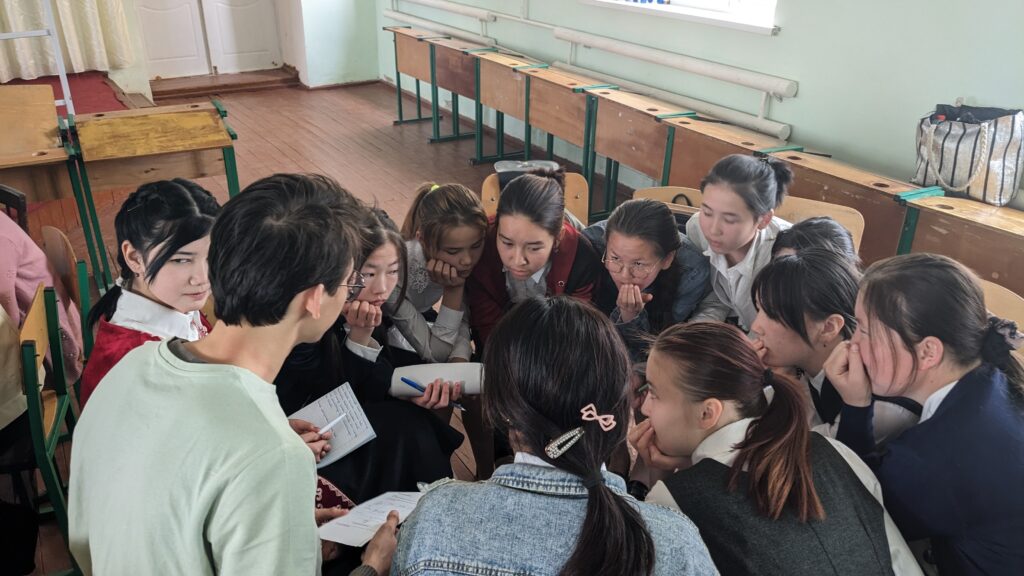
This paper describes the outcomes of a research aimed to assess the viability of Group Model Building (GMB) to catch the environmental degradation challenges in the Republic of Karakalpakstan (Uzbekistan) from the perspective of rural youth. In terms of methodology and approach, the corresponding workshops were conducted with 53 high school students in Janbasqala Village to map local factors affecting water quality and access. The Social Ecological Systems (SES) framework was applied as the working theory. The study’s preliminary results indicate the need for a multi-faceted intervention to address current farming practices and water consumption trends. In this context, the GMB approach acted as a platform to train the youth in systems thinking and elicit their views regarding causal relationships and feedback loops contributing to their everyday challenges. The investigation was limited by the short time commitment allotted and the focus on only a youth cohort. The findings support the viability of using GMB for environmental education and capacity-building in resource-constrained rural settings. The social implications are that GMB fosters ecological awareness and cohesion among youth, helping them articulate pathways for community-based adaptation and innovation. The mapping indicates the general trends of solastalgia negatively affecting the SES adaptability. The study has uniquely utilized GMB as a participatory research method with youth in the Aral Sea Basin, mapping how local perceptions of water and land degradation can inform SES resilience strategies, as well as has explored how solastalgia may be a factor in human-nature relations.
Download the Paper
Available in English
For citation: Robert Willard, Muzaffar Ismailov (2026). Group Model Building with Rural Youth for Social Ecological Systems in Karakalpakstan. Central Asian Journal of Sustainability and Climate Research, 5(1), 14-34. https://doi.org/10.29258/CAJSCR/2026-R1.v5-1/14-34.eng
Rerefences
Albrecht, G. (2005). ‘Solastalgia’ is a new concept in health and identity. Philosophical Activism in Nature 3, 41-55;
Anderies, J.M., Janssen, M.A. and Ostrom, E. (2004). A framework to analyze the robustness of social-ecological systems from an institutional perspective. Ecology and Society 9(1), 18 (http://www.ecologyandsociety.org/vol9/iss1/art18);
Brite, E.B. (2016). Irrigation in the Khorezm Oasis, past and present: A political ecology perspective. Political Ecol-ogy 23;
Château, P.-A. et al. (2012). Building a stakeholder’s vision of an offshore wind-farm project: A group modelling approach. Science of The Total Environment 420, 43-53 (https://doi.org/10.2458/v23i1.20177);
Craig, R.K. (2020). Resilience theory and wicked problems. Vanderbilt Law Review 73(6), 1733-1775 (https://doi.org/10.2139/ssrn.3610420);
Czucz, B., Csecserits, A., Botta-Dukat, Z., Kroel-Dulay, G., Szabo, R., Horvath, F. and Molnar, Z. (2011). An indi-cator framework for the climatic adaptive capacity of natural ecosystems. Journal of Vegetation Science 22, 711-725 (https://doi.org/10.1111/j.1654-1103.2011.01251.x);
Deliry, S.I., Avdan, Z.Y. and Avdan, U. (2020). Assessment of human-induced environmental disaster in the Aral Sea using Landsat satellite images. Environmental Earth Sciences 79(20) (https://doi.org/10.1007/s12665-020-09220);
Embergenov N.J, Tursinov M.J. and Auezov O.T. (2023). Population Migration of the Republic of Karakalpakstan and its Territorial Features. Eurasian Journal of History, Geography and Economics 18, 5-8 (https://geniusjournals.org/index.php/ejhge/article/view/3582);
Folke, K., Carpenter, S. and Walker, B. (2002). Building adaptive capacity in a world of transformations. Ambio 31(5), 447-440;
Galway, L.P., Beery, T., Jones-Casey, K. and Tasala, K. (2019). Mapping the Solastalgia Literature: A Scoping Re-view Study. International Journal of Environmental Research and Public Health 16(15), 2662 (https://doi.org/10.3390/ijerph16152662);
Groundstroem, F. & Juhola, S. (2021). Using systems thinking and causal loop diagrams to identify cascading cli-mate change impacts on bioenergy supply systems. Mitigation and Adaptation Strategies for Global Change 26(7), 1-48 (https://doi.org/10.1007/s11027-021-09967-0);
Hamza, K., Rich, K.M. and Wheat, I.D. (2014). A system dynamics approach to sea lice control in Norway. Aqua-culture Economics & Management 18(3), 344-368 (https://doi.org/10.1080/13657305.2014.959210);
Hernantes, J., Labaka, L., Lauge, A., Sarriegi, J.M. and Gonzalez, J. (2012). Group Model Building: A collaborative modelling methodology applied to critical infrastructure protection, Int. J. Organ. Des. Eng. 41-60 (https://doi.org/10.1504/IJODE.2012.045904);
Hovmand, P.S. (2014). Community-Based System Dynamics. Springer (https://doi.org/10.1007/978-1-4614-8763-0);
Huggins, X., Gleeson, T., Castilla-Rho, J., Holley, C., Re, V. and Famiglietti, J.S. (2023). Groundwater connections and sustainability in social-ecological systems (https://doi.org/10.31223/x5f93p);
Jarylkasinova, G. & Mavlyanov, I.R. (2020). Epidemiological analysis of the prevalence of iron deficiency anemia in the Republic of Uzbekistan for 2007-2019. Global Journal of Medical Research 20(17) (https://doi.org/10.17406/GJMR);
Lam, N., Arenas, H., Brito, P.L. and Liu, K.B. (2014). Assessment of vulnerability and adaptive capacity to coastal hazards in the Caribbean region. Journal of Coastal Research 70, 473-478 (http://doi.org/10.2112/SI70-080.1);
Leslie, P. & McCabe, T. (2013). Response diversity and resilience in social-ecological systems. Current Anthropolo-gy 54(2), 114-143 (https://doi.org/10.1086/669563);
Luna-Reyes, L.F., Martinez-Moyano, I.J., Pardo, T.A., Cresswell, A.M., Andersen, D.F. and Richardson, G.P. (2006). Anatomy of a group model-building intervention: Building dynamic theory from case study re-search. System Dynamics Review 22(4), 291-320 (https://doi.org/10.1002/sdr.349);
McGinnis, M.D. & Ostrom, E. (2014). Social-ecological system framework: Initial changes and continuing challeng-es. Ecology and Society 19(2), 30 (https://doi.org/10.5751/ES-06387-190230);
Micklin, P. (2010). The past, present, and future Aral Sea. Lakes & Reservoirs: Science, Policy and Management for Sustainable Use 15(3), 193-213 (https://doi.org/10.1111/j.1440-1770.2010.00437.x);
National Academies of Sciences, Engineering, and Medicine (2019). Building and measuring community resilience: Actions for communities and the Gulf Research Program. The National Academies Press (https://nap.nationalacademies.org/read/25383/chapter/1);
Rich, K.M., Berends, J. and Cooper, G.S. (2021). Enriching value chains through maps: Reflections and lessons from spatial group model building in Myanmar and India. Development in Practice advance online publication;
Rich, K.M., Rich, M. and Dizyee, K. (2018). Participatory systems approaches for urban and peri-urban agriculture planning: The role of system dynamics and spatial group model building. Agricultural Systems 160, 110-123 (https://doi.org/10.1016/j.agsy.2016.09.022);
Trani, J.F. et al. (2019). Strengthening child inclusion in the classroom in rural schools of Pakistan and Afghanistan: What did we learn by testing the system dynamics protocol for community engagement? Comparative and International Education 14(1), 158-181 (https://doi.org/10.1177/1745499919829230);
United Nations Development Programme, UNDP (2017). Needs of the Population of the Aral Sea Region. UNDP, Tashkent, Uzbekistan (https://www.undp.org/sites/g/files/zskgke326/files/migration/uz/un_uzb_survey_in_the_Aral_Sea_region_eng.pdf);
UNDP (2024). Opportunities for increasing the ambition and quality of Uzbekistan’s NDC2 (https://www.undp.org/ sites/g/files/zskgke326/files/2024-12/analytical_paper_on_opportunities_for_increasing_the_ambition_and_quality_of_uzbekistans_ndc2.pdf);
Wang, W., Samat, A., Abuduwaili, J., Ge, Y., De Maeyer, P. and van de Voorde, T. (2022). Temporal characteriza-tion of sand and dust storm activity and its climatic and terrestrial drivers in the Aral Sea Region. Atmos-pheric Research 275, 106242 (https://doi.org/10.1016/j.atmosres.2022.106242);
White, K.D. (2013). Nature-society linkages in the Aral Sea region. Journal of Eurasian Studies 4(1), 18-33 (https://doi.org/10.1016/j.euras.2012.10.003);
Ženko, M. & Menga, F. (2019). Linking water scarcity to mental health: Hydro-social interruptions in the Lake Ur-mia Basin, Iran. Water 11(5), 1092 (https://doi.org/10.3390/w11051092);
Zhang, W., Gowdy, M.J. and Bassi, A.M. (2019). Systems thinking: an approach for understanding eco-agri-food systems, TEEB for Agriculture & Food: Scientific and Economic Foundations 17-55, UN Environment (https://eprints.whiterose.ac.uk/id/eprint/164950/).
This post is also available in: English (Английский)
Aral Sea, Group Model Building, participatory modelling, Solastalgia, water scarcity, youth