Bottom-Up Approaches to Knowledge Coproduction in Pasture Management: The Case of Kyrgyzstan
Institut Français d’Etudes sur l’Asie Centrale
*Email: irene.mestre@cnrs.fr
https://doi.org/10.29258/CAJSCR/2026-R1.v5-1/35-52.eng
Thematic cluster: Sustainability, Landscape/Agriculture
Type of paper: Research paper
Jule 09, 2026
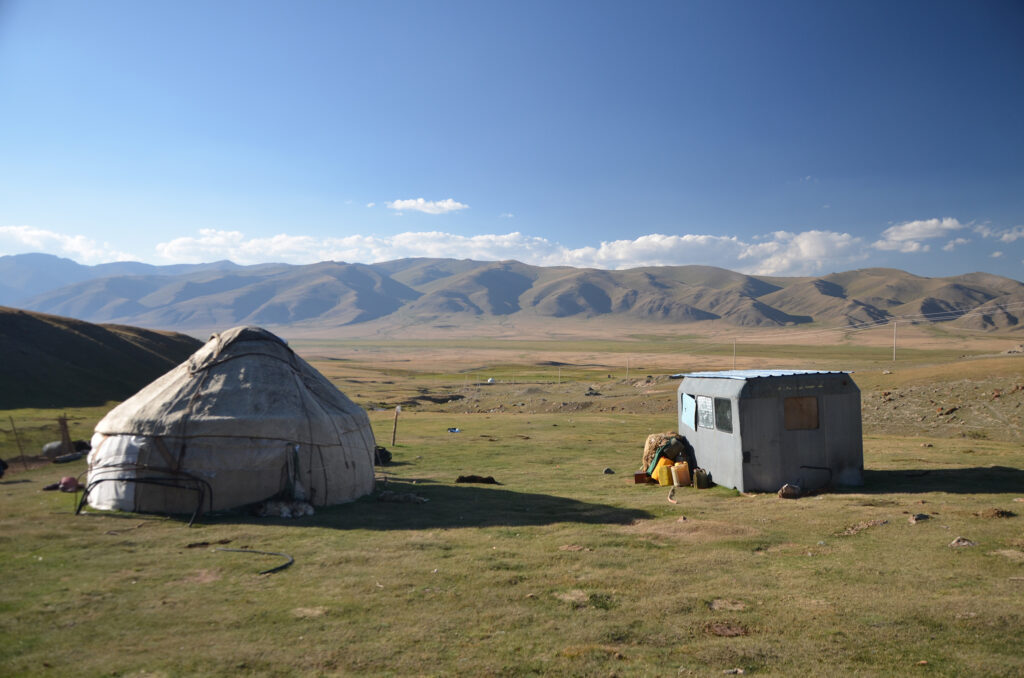
Solton Sary pastures, Naryn oblast, 2012. Credits: Irène Mestre
Abstract
This paper examines how local-level actors in Kyrgyzstan’s community-based pasture governance system have organised themselves to influence knowledge generation and policy-making. It explores the sophisticated interplay between decentralisation, stakeholder coordination, and power dynamics in pastoral resource management. The paper describes the findings of the qualitative embedded multiple case study conducted between 2011 and 2019. Six municipalities in Naryn and Jalal-Abad oblasts were studied through 99 semi-structured interviews, participatory observation within NGOs, and engagement with national stakeholders. Ostrom’s principles of sustainable community management were used as the analytical framework, complemented by literature on governance and social learning. Kyrgyzstan’s decentralisation reform created new governance entities, notably Pasture User Associations (PUAs) and their executive bodies, as well as Pasture Committees (PCs), operating within a fragmented institutional environment. PCs adapted flexibly but faced challenges in terms of coordination with state agencies and local actors. The establishment of the Kyrgyz Federation of Pasture User Associations (KFPUA) created a platform for political representation, knowledge sharing, and legitimacy building, fostering bottom-up influence on national policy. However, legislative inconsistencies and reliance on donor funding remain the key constraints. This research highlights the importance of local agency in shaping sustainable resource governance and promoting participatory policy processes.
Download the Paper
Available in English
For citation: Mestre, I. (2026). Participatory stakeholder approaches to and systemic thinking in agricultural production and resource use in Central Asia. Central Asian Journal of Sustainability and Climate Research, 5(1), 35-52. https://doi.org/10.29258/CAJSCR/2026-R1.v5-1/35-52.eng
Rerefences
Agrawal, A. (2001). Common Property Institutions and Sustainable Governance of Resources. World Development 29(10), 1649‑1672 (https://doi.org/10.1016/S0305-750X(01)00063-8);
Cox, M., Arnold, G. and Villamayor, T.S. (2010). A review of design principles for community-based natural resource management. Ecology and Society 15(4) (http://www.ecologyandsociety.org/vol15/iss4/art38/);
Crewett, W. (2012). Improving the Sustainability of Pasture Use in Kyrgyzstan. Mountain Research and Development 32(3), 267‑274 (https://doi.org/10.1659/MRD-JOURNAL-D-11-00128.1);
Crewett, W. (2015a). Decentralization in the Kyrgyz agricultural sector PhD Thesis, Humbolt University (https://doi.org/10.18452/17582);
Crewett, W. (2015b). Street-Level Bureaucrats at Work: A Municipality-Level Institutional Analysis of Community-Based Natural Resource Management Implementation Practice in the Pasture Sector of Kyrgyzstan. Sustainability 7(3), 3146‑3174 (https://doi.org/10.3390/su7033146);
Delgado-Serrano, M.M., Ramos, P.A. and Lasso Zapata, E. (2017). Using Ostrom’s DPs as Fuzzy Sets to Analyse How Water Policies Challenge Community-Based Water Governance in Colombia. Water 9(7), 535 (https://doi.org/10.3390/w9070535);
Dörre, A. (2012). Legal Arrangements and Pasture-Related Socio-ecological Challenges in Kyrgyzstan. In: H. Kreutzmann, ed. Pastoral practices in High Asia, 127‑144. Springer Netherlands (https://doi.org/10.1007/978-94-007-3846-1_7);
Dörre, A. (2015). Promises and realities of community-based pasture management approaches: Observations from Kyrgyzstan. Pastoralism: Research, Policy and Practice 5(15), 20 (https://doi.org/10.1186/s13570-015-0035-8);
Duncan, A. (1994). Agricultural and economic reform issues in Kyrgyzstan, former Soviet Central Asia. Food Policy 19(1), 85‑87 (https://doi.org/10.1016/0306-9192(94)90013-2);
Féaux de la Croix, J. (2011). Moral geographies in Kyrgyzstan: How pastures, dams and holy sites matter in striving for a good life. University of St Andrews (https://doi.org/10.1515/9783839436301);
Fitzherbert, A.R. (2006). Kyrgyzstan country pasture/forage resource profile (p. 31) [Working Paper], FAO (http://www.fao.org/ag/agp/agpc/doc/counprof/PDF%20files/Kyrgyzstan.pdf);
Galpin, C.J. (1915). The social anatomy of an agricultural community. Agricultural Experiment Station of the University of Wisconsin 34. Madison;
Hoppe, F., Kyzy, T.Z., Usupbaev, A. and Schickhoff, U. (2016). Rangeland degradation assessment in Kyrgyzstan: Vegetation and soils as indicators of grazing pressure in Naryn Oblast. Journal of Mountain Science 13(9), 1567‑1583 (https://doi.org/10.1007/s11629-016-3915-5);
Hurni, H., and U. Wiesmann. 2014. « Transdisciplinarity in Practice. Experience from a Concept-based Research Programme Addressing Global Change and Sustainable Development ». GAIA – Ecological Perspectives for Science and Society 23(3): 275‑77. (https://doi.org/10.14512/gaia.23.3.15);
Jacquesson, S. (2010a). Pastoralism: Historical anthropology of integration processes among the Kyrgyz of the Inner Tien Shan [fr. Pastoréalismes : Anthropologie historique des processus d’intégration chez les Kirghiz du Tian Shan intérieur]. L. Reichert Verl;
Jacquesson, S. (2010b). Reforming pastoral land use in Kyrgyzstan: From clan and custom to self-government and tradition. Central Asian Survey 29(1), 103‑118 (https://doi.org/10.1080/02634931003765571);
Kasymov, U., Undeland, A., Dörre, A. and Mackinnon, A. (2016). Central Asia: Kyrgyzstan and the learning experience in the design of pastoral institutions. International Office of Epizootics, Scientific and Technical Review [fr. Revue Scientifique Et Technique] 35(2), 511‑521 (https://doi.org/10.20506/rst.35.2.2538);
Kerven, C. (2006). Review of the literature on Pastral Economics and Marketing: Central Asia, China, Mongolia and Siberia (p. 33). WISP, GEF, UNDP, IUCN (https://iucn.org/sites/default/files/import/downloads /asia_reports.pdf);
Kerven, C., Steimann, B., Ashley, A., Dear, C. and Ur-Rahim, I. (2011). Pastoralism and farming in Central Asia’s mountains: A research review. Mountain Society Research Center, University of Central Asia [Background Paper] 1 (https://doi.org/10.5167/uzh-52730);
Kirch, P., Heinicke, T., Shepherd, G. and Zeitz, J. (2016). Application and Verification of Techniques for Visually Assessing Pasture Conditions in Mountainous Terrain: A Test of Three Field Assessment Methods in the Kyrgyz Republic. Mountain Research and Development 3(36), 355‑363 (https://doi.org/10.1659/MRD-JOURNAL-D-15-00049.1);
Academy of Sciences of the Kyrgyz Republic (1982). Kyrgyz Soviet Socialist Republic, Encyclopaedia [rus. Kirgizskaja Sovetskaja Socialičeskaja Respublika, Ènciklopedija]. Frunze;
Kyrgyz Federation of Pasture User Associations, KFPUA (2016a). Business plan [unpublished];
KFPUA (2016b). Charter (http://www.jayit.kg/en/about_us/charter);
KFPUA (2016c). 2016-2020 Strategic Plan (http://www.jayit.kg/en/about_us/strategic-plan);
Lerman, Z. & Zedik, D. (2009). Agrarian Reform in Kyrgyzstan: Achievements and the Unfinished Agenda [Discussion Paper No. 54160]. Hebrew University of Jerusalem, Department of Agricultural Economics and Management (http://econpapers.repec.org/paper/agshuaedp/54160.htm);
Levine, J., Isaeva, A., Eddy, I., Foggin, M., Gergel, S., Hagerman, S. and Zerriffi, H. (2017). A cognitive approach to the post-Soviet Central Asian pasture puzzle: New data from Kyrgyzstan. Regional Environmental Change 17(3), 941‑947 (https://doi.org/10.1007/s10113-017-1122-8);
Meadowcroft, J. 2009. « Who is in Charge here? Governance for Sustainable Development in a Complex World ». In Governance for Sustainable Development, Routledge;
Mestre, I. (2017a). Environmental approaches and pasture management: the case of Kyrgyzstan [fr. Approches environnementales et gestion des pâturages. Le cas du Kirghizstan]. Études rurales 200, 254‑273 (https://hal.science/hal-01907296);
Mestre, I. (2017b). When Shepherds Mine Mountains: The Impact of Artisanal Mining on Agropastoral Systems in Kyrgyzstan. Case Study of Naryn Province. Journal of Alpine Research | Revue de Géographie Alpine 105‑1 (https://doi.org/10.4000/rga.3611);
Mestre, I. (2019a). The contribution of community-based pastoral resource management to the resilience of post-Soviet rural communities: the case of Kyrgyzstan [fr. La contribution de la gestion communautaire des ressources pastorales à la résilience des communautés rurales post-soviétiques, le cas du Kirghizistan] Thesis, Université Jean Moulin – Lyon III (https://hal.archives-ouvertes.fr/tel-02464471);
Mestre, I. (2019b). The way to the pastures: How to reconcile community-based pasture management with mobility in agro-pastoral systems in the Naryn province of Kyrgyzstan. AGER: Journal of Depopulation and Rural Development Studies 26, 1‑37 (https://doi.org/10.4422/ager.2018.12);
Mestre, I., Ibraimova, A. and Azhibekov, B. (2013). Conflicts over pasture resources in the Kyrgyz Republic (p. 84) [Research]. ACTED; CAMP Alatoo (https://halshs.archives-ouvertes.fr/halshs-01240148);
Mogilevskii, R., Abdrazakova, N., Bolotbekova, A., Chalbasova, S., Dzhumaeva, S. and Tilekeyev, K. (2017). Sheep meat production value chains in the Kyrgyz Republic and export capacity to the EAEU member states [No. 36; Working Papers Series]. Institute of Public Policy and Administration, Bishkek;
Murzabekov, M. (2017). Political Pasture. A governmentality Analysis of Community-based Pasture Management in Kyrgyzstan [PhD Thesis, Uppsala University] (http://uu.divaportal.org/smash/record.jsf?pid=diva2%3A 1089170&dswid=-8105);
Ostrom, E. (1990). Governing the commons: The evolution of institutions for collective action. Cambridge University Press;
Ostrom, E. (2009). Understanding institutional diversity. Princeton university press;
Pahl-Wostl, C., Craps, M., Dewulf, A., Mostert, E., Tabara, D. and Taillieu, T. (2007). Social Learning and Water Resources Management. Ecology and Society 12(2) (https://doi.org/10.5751/ES-02037-120205);
Petric, B. (2015). Where Are All Our Sheep?: Kyrgyzstan, A Global Political Arena. Berghahn Books, New-York, Oxford;
Poteete, A.R., Janssen, M.A. and Ostrom, E. (2010). Working together: Collective action, the commons, and multiple methods in practice. Princeton University Press;
Poteete, A.R. & Ostrom, E. (2007). Fifteen years of empirical research on collective action in natural resource management: Struggling to build large-N databases based on qualitative research. World Development 36(1), 176‑195;
Rist, S., Chidambaranathan, M., Escobar, C., Wiesmann, U. and Zimmermann, A. (2007). Moving from sustainable management to sustainable governance of natural resources: The role of social learning processes in rural India, Bolivia and Mali. Journal of Rural Studies 23(1), article 1 (https://doi.org/10.1016/j.jrurstud.2006.02.006);
Robinson, S. (2016). Land Degradation in Central Asia: Evidence, Perception and Policy. In: R. Behnke & M. Mortimore, eds. The End of Desertification? (p. 451‑490). Springer, Berlin, Heidelberg (https://doi.org/10.1007/978-3-642-16014-1_17);
Robinson, S., Milner-Gulland, E.J. and Alimaev, I.I. (2003). Rangeland degradation in Kazakhstan during the Soviet era: Re-examining the evidence. Journal of Arid Environments 53(3), 419‑439;
Robinson, S., Wiedemann, Ch., Michel, S., Zhumabayev, Ye. and Singh, N. (2012). Pastoral Tenure in Central Asia: Theme and Variation in the Five Former Soviet Republics. In: Rangeland Stewardship in Central Asia, ed. Victor Squires. Springer Netherlands, 239 74 (http://link.springer.com/chapter/10.1007/978-94-007-5367-9_11);
Sacken, P.R.O. & Morgan, E.D. (1870). Expedition to the Trans-Naryn Country in 1867. Proceedings of the Royal Geographical Society of London 14(3), 221‑229 (https://doi.org/10.2307/1799053);
Schmitt, F. (2015). « ‘Functional’ Governance as an Alternative to ‘Territorial’ Governance? The Case of the Kyrgyz Irrigation Sector and the Implementation of Water User Associations (WUAs) ». Crossroads Asia (30): 33;
Severcov, N. A. (1873). The Journey Across the Turkestan Area [rus. Putešestvija po Turkestanskomu kraju]. State Geography Literature Publishing House, Saint-Petersburg (https://new.bizdin.kg/kniga/severtsov-puteshestvie-po-turkestanskomu-krayu);
Steimann, B. (2011). Making a living in uncertainty: Agro-pastoral livelihoods and institutional transformations in post-socialist rural Kyrgyzstan. Department of Geography, Division of Human Geography, University of Zurich;
Van Veen, T.W.S. (1995). The Kyrgyz sheep herders at a crossroads. Pastoral Development Network Series 38, 14;
Yin, R.K. (2011). Qualitative research from start to finish. The Guilford Press. New-York;
Žaparov, A. (2011). Regarding the current identity of the “nomadic” pastoralists of Naryn Region [fr. À propos de l’identité actuelle des pasteurs “nomades” de la région de Naryn]. Cahiers d’Asie centrale 19‑20, 327‑344;
Zhumanova, M., Wrage-Mönnig, N. and Darr, D. (2016). Farmers’ Decision-making and Land Use Changes in Kyrgyz Agropastoral Systems. Mountain Research and Development 36(4), 506‑517 (https://doi.org/10.1659/MRD-JOURNAL-D-16-00030.1);
Zhumanova, M., Wrage-Mönnig, N. and Jurasinski, G. (2021). Long-term vegetation change in the Western Tien-Shan Mountain Pastures, Central Asia, driven by a combination of changing precipitation patterns and grazing pressure. Science of The Total Environment, 146720 (https://doi.org/10.1016/j.scitotenv.2021.146720).
This post is also available in: Русский (Russian)
climate change, common-pool resources, Community-based, decentralisation, economics of land restoration, economics-of-land-restoration, ecosystem services valuation, ecosystem-services-valuation, governance, investment returns, investment-returns, pastoralism, social learning, Total economic value, total-economic-value