Восходящие подходы к совместному производству знаний в управлении пастбищами: на примере Кыргызстана
Institut Français d’Etudes sur l’Asie Centrale, Isanova street 24, Bishkek, Kyrgyz Republic
*Email: irene.mestre@cnrs.fr
https://doi.org/10.29258/CAJSCR/2026-R1.v5-1/35-52.eng
Тематический кластер: Устойчивое развитие, Ландшафт / Сельское хозяйство
Тип статьи: Научная статья
Июль 09, 2026
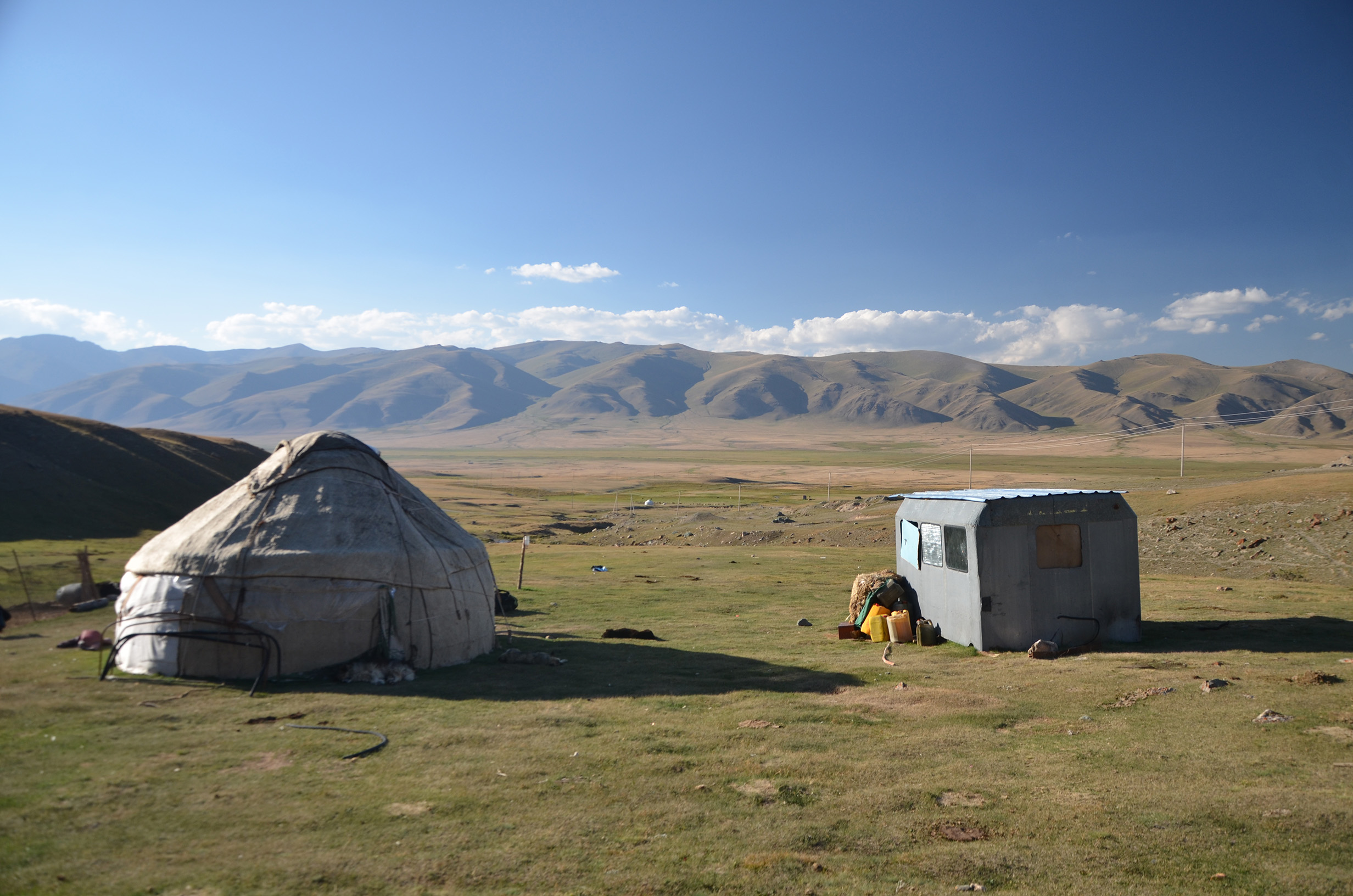
Пастбища Солтон-Сары, Нарынская область, 2012 г. Фото: Ирен Местре
Abstract
Данная статья исследует, как акторы местного уровня в системе общинного управления пастбищами Кыргызстана организовались для влияния на производство знаний и формирование политики. В ней рассматривается сложное взаимодействие между децентрализацией, координацией заинтересованных сторон и динамикой власти в управлении пастбищными ресурсами. В статье описываются результаты качественного встроенного множественного кейс-стади, проведённого в период с 2011 по 2019 год. Шесть муниципалитетов (айылных аймаков) в Нарынской и Джалал-Абадской областях были изучены посредством 99 полуструктурированных интервью, включённого наблюдения в НПО и взаимодействия с национальными заинтересованными сторонами. Принципы устойчивого общинного управления Остром были использованы в качестве аналитической рамки, дополненной литературой по вопросам управления и социального обучения. Реформа децентрализации в Кыргызстане создала новые управленческие структуры, в частности объединения пастбищепользователей и их исполнительные органы, а также Пастбищные комитеты (ПК), действующие в фрагментированной институциональной среде. ПК гибко адаптировались, однако сталкивались с трудностями в координации с государственными органами и местными акторами. Создание Национальной Ассоциации пастбищепользователей обеспечило платформу для политического представительства, обмена знаниями и формирования легитимности, способствуя восходящему влиянию на национальную политику. Тем не менее противоречия в законодательстве и зависимость от донорского финансирования остаются ключевыми ограничениями. Данное исследование подчёркивает значение местной агентивности в формировании устойчивого управления ресурсами и содействии партисипативным процессам формирования политики.
Download the Paper
Available in English
Для цитирования: Mestre, I. (2026). Participatory stakeholder approaches to and systemic thinking in agricultural production and resource use in Central Asia. Central Asian Journal of Sustainability and Climate Research, 5(1), 35-52. https://doi.org/10.29258/CAJSCR/2026-R1.v5-1/35-52.eng
Rerefences
Agrawal, A. (2001). Common Property Institutions and Sustainable Governance of Resources. World Development 29(10), 1649‑1672 (https://doi.org/10.1016/S0305-750X(01)00063-8);
Cox, M., Arnold, G. and Villamayor, T.S. (2010). A review of design principles for community-based natural resource management. Ecology and Society 15(4) (http://www.ecologyandsociety.org/vol15/iss4/art38/);
Crewett, W. (2012). Improving the Sustainability of Pasture Use in Kyrgyzstan. Mountain Research and Development 32(3), 267‑274 (https://doi.org/10.1659/MRD-JOURNAL-D-11-00128.1);
Crewett, W. (2015a). Decentralization in the Kyrgyz agricultural sector PhD Thesis, Humbolt University (https://doi.org/10.18452/17582);
Crewett, W. (2015b). Street-Level Bureaucrats at Work: A Municipality-Level Institutional Analysis of Community-Based Natural Resource Management Implementation Practice in the Pasture Sector of Kyrgyzstan. Sustainability 7(3), 3146‑3174 (https://doi.org/10.3390/su7033146);
Delgado-Serrano, M.M., Ramos, P.A. and Lasso Zapata, E. (2017). Using Ostrom’s DPs as Fuzzy Sets to Analyse How Water Policies Challenge Community-Based Water Governance in Colombia. Water 9(7), 535 (https://doi.org/10.3390/w9070535);
Dörre, A. (2012). Legal Arrangements and Pasture-Related Socio-ecological Challenges in Kyrgyzstan. In: H. Kreutzmann, ed. Pastoral practices in High Asia, 127‑144. Springer Netherlands (https://doi.org/10.1007/978-94-007-3846-1_7);
Dörre, A. (2015). Promises and realities of community-based pasture management approaches: Observations from Kyrgyzstan. Pastoralism: Research, Policy and Practice 5(15), 20 (https://doi.org/10.1186/s13570-015-0035-8);
Duncan, A. (1994). Agricultural and economic reform issues in Kyrgyzstan, former Soviet Central Asia. Food Policy 19(1), 85‑87 (https://doi.org/10.1016/0306-9192(94)90013-2);
Féaux de la Croix, J. (2011). Moral geographies in Kyrgyzstan: How pastures, dams and holy sites matter in striving for a good life. University of St Andrews (https://doi.org/10.1515/9783839436301);
Fitzherbert, A.R. (2006). Kyrgyzstan country pasture/forage resource profile (p. 31) [Working Paper], FAO (http://www.fao.org/ag/agp/agpc/doc/counprof/PDF%20files/Kyrgyzstan.pdf);
Galpin, C.J. (1915). The social anatomy of an agricultural community. Agricultural Experiment Station of the University of Wisconsin 34. Madison;
Hoppe, F., Kyzy, T.Z., Usupbaev, A. and Schickhoff, U. (2016). Rangeland degradation assessment in Kyrgyzstan: Vegetation and soils as indicators of grazing pressure in Naryn Oblast. Journal of Mountain Science 13(9), 1567‑1583 (https://doi.org/10.1007/s11629-016-3915-5);
Hurni, H., and U. Wiesmann. 2014. « Transdisciplinarity in Practice. Experience from a Concept-based Research Programme Addressing Global Change and Sustainable Development ». GAIA — Ecological Perspectives for Science and Society 23(3): 275‑77. (https://doi.org/10.14512/gaia.23.3.15);
Jacquesson, S. (2010a). Pastoralism: Historical anthropology of integration processes among the Kyrgyz of the Inner Tien Shan [fr. Pastoréalismes : Anthropologie historique des processus d’intégration chez les Kirghiz du Tian Shan intérieur]. L. Reichert Verl;
Jacquesson, S. (2010b). Reforming pastoral land use in Kyrgyzstan: From clan and custom to self-government and tradition. Central Asian Survey 29(1), 103‑118 (https://doi.org/10.1080/02634931003765571);
Kasymov, U., Undeland, A., Dörre, A. and Mackinnon, A. (2016). Central Asia: Kyrgyzstan and the learning experience in the design of pastoral institutions. International Office of Epizootics, Scientific and Technical Review [fr. Revue Scientifique Et Technique] 35(2), 511‑521 (https://doi.org/10.20506/rst.35.2.2538);
Kerven, C. (2006). Review of the literature on Pastral Economics and Marketing: Central Asia, China, Mongolia and Siberia (p. 33). WISP, GEF, UNDP, IUCN (https://iucn.org/sites/default/files/import/downloads /asia_reports.pdf);
Kerven, C., Steimann, B., Ashley, A., Dear, C. and Ur-Rahim, I. (2011). Pastoralism and farming in Central Asia’s mountains: A research review. Mountain Society Research Center, University of Central Asia [Background Paper] 1 (https://doi.org/10.5167/uzh-52730);
Kirch, P., Heinicke, T., Shepherd, G. and Zeitz, J. (2016). Application and Verification of Techniques for Visually Assessing Pasture Conditions in Mountainous Terrain: A Test of Three Field Assessment Methods in the Kyrgyz Republic. Mountain Research and Development 3(36), 355‑363 (https://doi.org/10.1659/MRD-JOURNAL-D-15-00049.1);
Academy of Sciences of the Kyrgyz Republic (1982). Kyrgyz Soviet Socialist Republic, Encyclopaedia [rus. Kirgizskaja Sovetskaja Socialičeskaja Respublika, Ènciklopedija]. Frunze;
Kyrgyz Federation of Pasture User Associations, KFPUA (2016a). Business plan [unpublished];
KFPUA (2016b). Charter (http://www.jayit.kg/en/about_us/charter);
KFPUA (2016c). 2016-2020 Strategic Plan (http://www.jayit.kg/en/about_us/strategic-plan);
Lerman, Z. & Zedik, D. (2009). Agrarian Reform in Kyrgyzstan: Achievements and the Unfinished Agenda [Discussion Paper No. 54160]. Hebrew University of Jerusalem, Department of Agricultural Economics and Management (http://econpapers.repec.org/paper/agshuaedp/54160.htm);
Levine, J., Isaeva, A., Eddy, I., Foggin, M., Gergel, S., Hagerman, S. and Zerriffi, H. (2017). A cognitive approach to the post-Soviet Central Asian pasture puzzle: New data from Kyrgyzstan. Regional Environmental Change 17(3), 941‑947 (https://doi.org/10.1007/s10113-017-1122-8);
Meadowcroft, J. 2009. « Who is in Charge here? Governance for Sustainable Development in a Complex World ». In Governance for Sustainable Development, Routledge;
Mestre, I. (2017a). Environmental approaches and pasture management: the case of Kyrgyzstan [fr. Approches environnementales et gestion des pâturages. Le cas du Kirghizstan]. Études rurales 200, 254‑273 (https://hal.science/hal-01907296);
Mestre, I. (2017b). When Shepherds Mine Mountains: The Impact of Artisanal Mining on Agropastoral Systems in Kyrgyzstan. Case Study of Naryn Province. Journal of Alpine Research | Revue de Géographie Alpine 105‑1 (https://doi.org/10.4000/rga.3611);
Mestre, I. (2019a). The contribution of community-based pastoral resource management to the resilience of post-Soviet rural communities: the case of Kyrgyzstan [fr. La contribution de la gestion communautaire des ressources pastorales à la résilience des communautés rurales post-soviétiques, le cas du Kirghizistan] Thesis, Université Jean Moulin — Lyon III (https://hal.archives-ouvertes.fr/tel-02464471);
Mestre, I. (2019b). The way to the pastures: How to reconcile community-based pasture management with mobility in agro-pastoral systems in the Naryn province of Kyrgyzstan. AGER: Journal of Depopulation and Rural Development Studies 26, 1‑37 (https://doi.org/10.4422/ager.2018.12);
Mestre, I., Ibraimova, A. and Azhibekov, B. (2013). Conflicts over pasture resources in the Kyrgyz Republic (p. 84) [Research]. ACTED; CAMP Alatoo (https://halshs.archives-ouvertes.fr/halshs-01240148);
Mogilevskii, R., Abdrazakova, N., Bolotbekova, A., Chalbasova, S., Dzhumaeva, S. and Tilekeyev, K. (2017). Sheep meat production value chains in the Kyrgyz Republic and export capacity to the EAEU member states [No. 36; Working Papers Series]. Institute of Public Policy and Administration, Bishkek;
Murzabekov, M. (2017). Political Pasture. A governmentality Analysis of Community-based Pasture Management in Kyrgyzstan [PhD Thesis, Uppsala University] (http://uu.divaportal.org/smash/record.jsf?pid=diva2%3A 1089170&dswid=-8105);
Ostrom, E. (1990). Governing the commons: The evolution of institutions for collective action. Cambridge University Press;
Ostrom, E. (2009). Understanding institutional diversity. Princeton university press;
Pahl-Wostl, C., Craps, M., Dewulf, A., Mostert, E., Tabara, D. and Taillieu, T. (2007). Social Learning and Water Resources Management. Ecology and Society 12(2) (https://doi.org/10.5751/ES-02037-120205);
Petric, B. (2015). Where Are All Our Sheep?: Kyrgyzstan, A Global Political Arena. Berghahn Books, New-York, Oxford;
Poteete, A.R., Janssen, M.A. and Ostrom, E. (2010). Working together: Collective action, the commons, and multiple methods in practice. Princeton University Press;
Poteete, A.R. & Ostrom, E. (2007). Fifteen years of empirical research on collective action in natural resource management: Struggling to build large-N databases based on qualitative research. World Development 36(1), 176‑195;
Rist, S., Chidambaranathan, M., Escobar, C., Wiesmann, U. and Zimmermann, A. (2007). Moving from sustainable management to sustainable governance of natural resources: The role of social learning processes in rural India, Bolivia and Mali. Journal of Rural Studies 23(1), article 1 (https://doi.org/10.1016/j.jrurstud.2006.02.006);
Robinson, S. (2016). Land Degradation in Central Asia: Evidence, Perception and Policy. In: R. Behnke & M. Mortimore, eds. The End of Desertification? (p. 451‑490). Springer, Berlin, Heidelberg (https://doi.org/10.1007/978-3-642-16014-1_17);
Robinson, S., Milner-Gulland, E.J. and Alimaev, I.I. (2003). Rangeland degradation in Kazakhstan during the Soviet era: Re-examining the evidence. Journal of Arid Environments 53(3), 419‑439;
Robinson, S., Wiedemann, Ch., Michel, S., Zhumabayev, Ye. and Singh, N. (2012). Pastoral Tenure in Central Asia: Theme and Variation in the Five Former Soviet Republics. In: Rangeland Stewardship in Central Asia, ed. Victor Squires. Springer Netherlands, 239 74 (http://link.springer.com/chapter/10.1007/978-94-007-5367-9_11);
Sacken, P.R.O. & Morgan, E.D. (1870). Expedition to the Trans-Naryn Country in 1867. Proceedings of the Royal Geographical Society of London 14(3), 221‑229 (https://doi.org/10.2307/1799053);
Schmitt, F. (2015). « ‘Functional’ Governance as an Alternative to ‘Territorial’ Governance? The Case of the Kyrgyz Irrigation Sector and the Implementation of Water User Associations (WUAs) ». Crossroads Asia (30): 33;
Severcov, N. A. (1873). The Journey Across the Turkestan Area [rus. Putešestvija po Turkestanskomu kraju]. State Geography Literature Publishing House, Saint-Petersburg (https://new.bizdin.kg/kniga/severtsov-puteshestvie-po-turkestanskomu-krayu);
Steimann, B. (2011). Making a living in uncertainty: Agro-pastoral livelihoods and institutional transformations in post-socialist rural Kyrgyzstan. Department of Geography, Division of Human Geography, University of Zurich;
Van Veen, T.W.S. (1995). The Kyrgyz sheep herders at a crossroads. Pastoral Development Network Series 38, 14;
Yin, R.K. (2011). Qualitative research from start to finish. The Guilford Press. New-York;
Žaparov, A. (2011). Regarding the current identity of the “nomadic” pastoralists of Naryn Region [fr. À propos de l’identité actuelle des pasteurs “nomades” de la région de Naryn]. Cahiers d’Asie centrale 19‑20, 327‑344;
Zhumanova, M., Wrage-Mönnig, N. and Darr, D. (2016). Farmers’ Decision-making and Land Use Changes in Kyrgyz Agropastoral Systems. Mountain Research and Development 36(4), 506‑517 (https://doi.org/10.1659/MRD-JOURNAL-D-16-00030.1);
Zhumanova, M., Wrage-Mönnig, N. and Jurasinski, G. (2021). Long-term vegetation change in the Western Tien-Shan Mountain Pastures, Central Asia, driven by a combination of changing precipitation patterns and grazing pressure. Science of The Total Environment, 146720 (https://doi.org/10.1016/j.scitotenv.2021.146720).
This post is also available in: English (Английский)
climate change, climate change, economics of land restoration, economics of land restoration, economics-of-land-restoration, ecosystem services valuation, ecosystem services valuation, ecosystem-services-valuation, investment returns, investment returns, investment-returns, Total economic value, Total economic value, total-economic-value